Saturday, July 31, 2010

Sir John Barbirolli - Great Conductors of the 20th Century


The Barbirolli volume in the Great Conductors series focuses on relatively rare items in his discography. This Elgar Enigma Variations, for example, is his first stereo version, not the later, better-known one. The latter boasts a better orchestra, but this 1956 Pye release has a lot going for it too, not least the extra touch of warmth in the string-centered slower variations like "Nimrod".

There's also a long out-of-print Ravel Mother Goose Suite with the Halle winds a bit overextended, a heavyweight Meistersinger Act One Prelude, and a magnificent "Love Duet" from one of Barbirolli's rare complete opera recordings, Puccini's Madama Butterfly, with Scotto and Bergonzi in great voice.

The real rarity though, is the Mahler Second, a work Barbirolli often performed in his later years but never recorded. EMI provides incisive cleaned-up stereo sound for this live performance from Stuttgart made shortly before his death. Barbirolli's performance is full of passionate fervor but the execution is often slipshod. Still, admirers of Barbirolli's Mahler will want his only available Mahler Second. --Dan Davis

cd info

flac, scans

Friday, July 30, 2010

Stravinsky - Firebird, Petrushka - Rattle, Co Birmingham SO 2CD


  click the cver to download

 cover back


Originally recorded in 1986 and 1987 and issued as two separate albums, this 2003 compilation pairs two of Igor Stravinsky's most popular ballets, and offers some less familiar but fascinating works as filler. Sir Simon Rattle and the City of Birmingham Symphony Orchestra  deliver exciting performances of The Firebird and Petrushka in their complete versions, and these will come as a revelation to those who only know the concert suites. The Igor Stravinskyrecordings are clearly detailed, vibrantly colorful, and emotionally compelling, and are especially recommended to beginners as excellent introductions to Stravinsky's music. In its jovial "Shrovetide Fair" atmosphere, the Scherzo à la Russe is a close cousin to Petrushka, and appears here in two enjoyable versions, one for jazz band and the other in the ebullient orchestral arrangement. The spiky Symphony in Three Movements, based in part on material for a scrapped piano concerto, and the Etudes (4) for orchestra, an arrangement of the Pieces (3) for string quartet and the Etude for Pianola, are less immediately accessible, but Stravinsky buffs will find them rewarding on repeated listening. An EMI/Gemini double-disc, this affordable reissue is sure to please collectors and newcomers alike for its masterful performances and high quality sound. ~ Blair Sanderson, Rovi 

cd info

flac


Thursday, July 29, 2010

Bizet - L'Arlesienne- Incidental Music - Plasson, Capitole de Toulouse


 Back cover


Those who love the music of Georges Bizet  have only two regrets: first, that the composer died too young to have reached full maturity and second, that he left so little truly great music behind. Three years before his death at 37, Bizet was commissioned to write the incidental music to Alphonse Daudet's play L'Arlésienne. Wildly unpopular, the play closed after 21 performances, but Bizet, realizing the score's worth, arranged four pieces from it as a suite for full orchestra -- and achieved a popular hit that paved the way for his masterpiece Carmen. But while the suite remains extremely well-known, the remainder of the music is all but unknown except to the most dedicated Bizet fan. This 1985 performance by Michel Plasson  leading the Orchestre du Capitole de Toulouse and the Orféon Donostiarra in the complete L'Arlésienne incidental music was the work's first digital recording, and it still sounds beautiful in this 2006 remastering: deep, smooth, brilliantly colorful, and very immediate.

Georges Bizet Better yet, it was a great performance. At the time, Plasson and the Toulouse orchestra were in the midst of recording vast swathes of the French late-Romantic orchestral repertoire, and in the midst of immensely serious symphonies by d'Indy, Magnard, and Ropartz, it must have been a balm and a joy for them to record Bizet's endlessly fresh score. Their performance ideally catches the work's spirit of reckless youth in playing of eager energy and keen enjoyment. But that doesn't mean the music's darker strains aren't given their full weight: the 11-minute Finale is as dark as the darkest French romantic music. While not the cogent and compelling musical theater experience that Carmen is, L'Arlésienne is still first-rate Bizet and anyone who only knows the suite will surely enjoy the complete incidental music. ~ James Leonard, Rovi


cd info

flac, scans

Wednesday, July 28, 2010

Gliere, Reinhold - The Red Poppy (Ballet) - St. Petersburg SO 2CD

Click on the cover to download
Gliere, ballet, The Red Poppy

Gliere's music sounds like it was written at least half a century earlier than it actually was. A composer who lived until mid-century, you'd never guess that he wasn't a contemporary of Tchaikovsky. His ballet music has the same Romantic sheen to it, with sweeping violin melodies and characterful individual dances. What he lacks is Tchaikovsky's sense of symphonic continuity, but his sense of dramatic timing seems to have been spot on, at least as far as this work is concerned. The only part of it that's at all well known is the "Russian Sailors' Dance," but there's lots more besides that's every bit as entertaining, so all credit to Naxos for giving us the complete work in such a fine performance at budget price. --David Hurwitz

The ballet takes place at a seaport in 1920s-era Kuomintang  China. A ship carrying sailors from many lands, including Russia is docked in a Chinese seaport. The captain notices a group of half-starved, overworked Coolies  being brutally driven to work even harder by their cruel harbormaster. One night while dancing for the sailors aboard the ship, the beautiful Tao-Hoa (Pinyin: Taohua) notices a Russian captain trying to rescue the poor Coolies from the port commander. Impressed by the captain's act of kindness she gives him a red poppy  as a symbol of her love. When Tao's employer, Li Shan-Fu learns of this, he is jealous and orders her to kill the captain. She refuses, sacrifices her life for the captain's, and is later killed by her employer when a riot breaks out on the dock. As she dies, she gives another red poppy flower to a young Chinese girl as a sign of love and freedom.
flac, scans

Tuesday, July 27, 2010

David Helfgott - plays Rachmaninov


Click the cover to download

back


One of the more controversial figures in classical music would have to be David Helfgott (1947), an Australian pianist who is just as famous for his schizophrenia as for his performances.

After having read the many negative reviews of this CD it was time to really get into this recording. First off, everyone seems to review the movie ( Shine ) and to reveal their personal prejudices against those with a mental illness. This consumes their entire review and we never learn if this is a good performance or a bad one divorced from these sentiments. From the viewpoint of someone in the audience, the Rachmaninoff Third Concerto comes off very well. The orchestra under Milan Horvot is a first rate ensemble and Horvat is a more than capable accompanist. The miking may be close but at least we know that there actually IS an orchestra there unlike many recordings of this piece. Secondly, if seen as a whole, Helgott turns in an interesting performance that is at time softer and lighter than we are used hearing. The bluff and bluster of many with no feeling for this work (one pianist did this work 4 times on records and never came to a cohesive ideal) is totally absent here. Any obsessiveness with detail doesn't exist in this performance. What we do hear is a pianist who has something to say about this work--it may not be according to the rigid standards of many but it is a valid statement. This may never be a recording to top anybody's list. However the Third Concerto as played here is given a great, sturdy rendition worthy of respect. The three preludes by Rachmaninoff Rachmaninoff are performed as perfectly shaped little pearls. The Second Piano Sonata is like the Third Piano Concerto--there have been too few recordings that actually great due to its thorny score even when played with cuts. Of special merit is the second movement which Helfgott plays with gentleness. The third movement doesn't seem to come off--again, too few pianists can make it through this work. However, the attempt here is balanced and right as rain. Again, this may not stand with the immortal performances. However, everyone is entitled to an opinion. And this performance by Helfgott will stand the test of time.--Amazon

or

Is it “the most awful commercial recording of the Rachmaninoff Third ever released”!?

more info

flac, covers

Enhanced by Zemanta

Monday, July 26, 2010

Janacek - Glagolitic Mass, Taras Bulba - Ancerl, Czech PO


Click the cover to download

back cover


Supraphon is overselling by calling all of is recorded output gold, but there are many arresting performances in the series. This one of the Glagolitic Mass, released in 1964, is one of them. It wasn't in Ancerl's nature to be as raw and fierce in this score as Kubelik and others have been. He is often lyrical and tender. Fortunately for him, he has a soprano and tenor who encompass their treacherous parts without screaming. The Czech chorus is the best-sounding, most idiomatic and comfortable that I've ever heard. The Czech Phil. is more rustic -- or is it ragged? -- than several of the international orchestras who have recorded the work, but they too sound completely at home. I agree with the original Gramophone critic who found the organist too tame for his wild obligatto outburst. The same reviewer compared the late Mass with the Sinfonietta written just before it when Janacek was 72 and entering his miraculous late phase, which he called a "new jet from my soul": The Mass displays "the same brightness and pungency of timbre, the same fertile, vigorous way of building whole movements from a single motif."

Supraphon's sound has come up well in remastering, with clarity from orchestra, soloists and chorus. This recording has a you-are-there presence that immediately captures your attention, and it never loses its musicality in the midst of Janacek's impassioned exclamations. Only some strained, wobbly singing here and there is a drawback; otherwise, this reading is a Janacekstandout in the catalog. As for the filler, Taras Bulba, I've been very little focused on Janacek's orchestral productions. The idiom of this three-movement Rhapsody for Orchestra combines diffuse, almost easy-listen romanticism with enough mystery and tangy dissonance to tell us immediately who the composer is. It dates from 1918, when Janacek was 64; the great flood of late operas was two years away, Jenufa was 14 years behind. Ancerl gives it a piquant, sharply etched reading.

more info

flac, scans


Sunday, July 25, 2010

Bach JS – The Well-Tempered Clavier - Daniel Barenboim 5CD

front

more info


Bach The Well-Tempered Clavier, Book II (disc1) - front

Barenboim's Bach has a refreshing "Old World" quality, reflecting his rounded tone, moderate tempos, and emphasis on harmonic tension. Better known these days as a conductor, Barenboim has continued his career as a major pianist, his technique remains fresh, his interpretations, even more insightful. This is heard in the fluency of his playing and the clarity he brings to the fugal lines. Barenboim maintains the individuality of each of the preludes and fugues, and his emphasis on harmony brings out the unfolding mystery inherent in the C-sharp minor Fugue and the D-sharp Prelude, the Fugue of which swells from its pianissimo statement to multiple voices of rising discourse full of meaning. He's as capable of projecting the wit of the A minor Prelude as he is in dazzling with the swift finger work of the C major Fugue or conveying the gracious elegance of the D minor Prelude. Barenboim's unabashed pianism and interpretive insights make this among the best piano versions, coming much closer than most to penetrating the myriad mysteries of Bach's masterpiece. --Dan Davis

flac and scans

Saturday, July 24, 2010

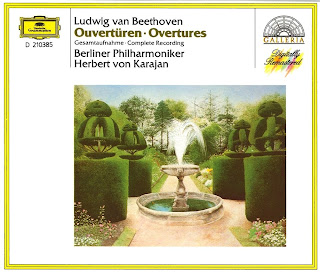
Beethoven - Complete Overtures - Karajan, Berliner Philharmoniker 2CD


Recorded when the Berlin Philharmonic and Herbert von Karajan were in their plush phase, but under a full head of steam, these polished performances of the overtures are a visceral delight. The sensuous, bass-heavy textures and glistening gut-strung string playing are still something to marvel at. So are the outstanding solos in the winds and the potent proclamations of the brass, which had become impressively secure at this point in Karajan's reign, even though their tuning was still problematic. At times the treatment may seem just a bit Prussian and overbearing, and premeditated in effect rather than spontaneous. But the Olympian grandeur of the conceptions and the sense of festive sweep Karajan brings to the readings make this a set one can live with. The three overtures recorded in 1965 seem just a tiny bit fierce in the treble compared with the remainder; otherwise, the venue is the same and the engineering remarkably consistent. The sound is boomy in the louder passages, but there is excellent atmosphere in the quiet ones. --Ted Libbey


Friday, July 23, 2010

Ravel - Bolero, Rapsodie Espagnole etc - Dutoit, Montreal SO


Referring to Bolero, Ravel once remarked to his fellow composer Arthur Honegger that he had produced only one masterpiece, adding ruefully that it contained no music! He was right in a sense because this work owes its success precisely to its defiance of all the carefully elaborated traditions of Western classical music. What there is instead is one unforgettable tune, put through a kaleidoscopic sequence of colour-changes on a large orchestra -note the saxophones. Monotonous repetition of the tune and the steady crescendo throughout, combine to hypnotise the listener until all the electrifying tension explodes at the climax, with one shuddering change of key, and then a discord in the brass to finish. Inescapably, the effect is one of hysteria; the same hysteria that lurks over the end of La Valse, Unlike that work, the Bolero was danced at its first performance on 22 November 1928, and by that highly idiosyncratic figure, Ida Rubinstein. The choreography was the work of Nijinsky's sister, Bronislava Nijinska. The Bolero, though there is an obvious Spanish fiesta-like atmosphere present, is not actually a true bolero. Likewise, the Rapsodie espagnole is Spain seen through Debussy's Iberia, for Ravel, born near St.-Jean-de-Luz, was always fiercely proud of his Basque ancestry. The first performance of the Rapsodie espagnole was conducted by Edouard Colonne in Paris in March, 1908, although the origins of its third movement go back to the two-piano Piece en forme de habanera, written in 1895. The orchestral brilliance of the final exhilarating Feria is matched in another Spanish work, the Alborada del Gracioso, once again originally written for piano, as the fourth piece in the cycle Miroirs (1904-5). In its orchestral guise (1918), the fiendish repeated notes of the piano version are translated -although one is never aware of the process of translation -into a vivid Mediterranean panorama, wherein Ravel exploits to the full an enormous percussion section; watch out also for a perverse single bar of solo cello, An alborada is a morning serenade specially characteristic of Galicia and a gracioso is a jester in a Spanish nobleman's house. Ravel, along with composers as diverse as Debussy and Emmanuel Chabrier, clearly had a Spanish fixation, which showed itself in other works too, such as the opera L'Heure espagnole. But for one ofhis most powerful and disturbing works, La Valse, he turned not to Spain, but to ImperialVienna. The initial idea was Diaghllev's, in 1919; something of an olive branch, for Ravel had broken off diplomatic relations with the Ballets Russes over Daphnis et Chloe. Diaghilev, when commissioning Ravel, can hardly have expected anything ordinary, but even so he rejected La Valse with the astute observation that it was "not so much a ballet, as the portrait of a ballet". The wonder is that it has been danced so successfully since! The score still carries a brief scenario by the composer which places the action firmly in the Imperial Court, around 1855. But the music itself, though its Viennese roots are still apparent, gradually begins to breathe a different atmosphere. Vienna is all there, in the accelerandos and ritardandos, the exaggerated dynamics, the typical Straussian lead-ins and the glissandos (Ravel's use of this technique alone would fill a volume). But before our eyes (or ears), the waltz seems to be dissected; no wonder that La Valse ends not in a glorious apotheosis, but again in hysteria, in nightmare, frenzy, and even death.--Piers Burton-Page


Henze, Hans Werner - Undine , Ballet en three acts - Knussen, London Sinfonietta 2CD


It is always wonderful to encounter a work such as Henze's Undine, where you realize that what you've got is, in fact, a work that can stand alongside the best of Stravinsky's or Ravel's ballets. It is, in short, a genuine, riveting masterpiece. Originally titled "Ondine", Henze's ballet was written for Sir Frederick Ashton in 1958 and is based on a novella by Friedrich de la Motte Fouqué (the storyline is more or less the usual one). As Richard Jones put it, it is a "20th century full-length ballet score that has the depth of a masterwork." It is a luminous, variagetd but often ravishingly opulent, genuinely romantic score - modern, but mostly tonal and stylistically suggesting a mixture of Richard Strauss, Stravinsky and Ravel - but never sounding anything other than Henze himself (though Henze in his early, neo-classically oriented phase). It is instantly appealing and accessible, even though it would have been uncompromisingly modern in 1958 (the critical reactions at the time were mixed - it was seen as too modern by balletomanes and reactionary by the avant-garde movement).

The score opens magically and mysteriously, immediately setting the tone, but soon launches into quicker music of propulsive rhythms and ferocious drama. Throughout the work, the various elements are expertly put together (the combination of almost ethereally lush, atmospheric beauty and astringent intensity never sounds disjointed), with too many memorable moments to count, in particular among Henze's ingenious use of a huge variety of rhythmic tricks and techniques. It is always gorgeously colorful and wonderfully scored, never afraid of employing such elements as nature painting (sea evocations, deep forests, clouds, and they have rarely been more evocatively done), and culminating in a most absorbingly, heart-renderingly moving passacaglia - in short, Henze's Undine manages to achieve the trick of being an obvious continuation of the balletic tradition preceding it while at the same time being innovatively modern, and one of the greatest ballets of all time to boost.

Fortunately, the performance is itself a wonder. I cannot really imagine a more mesmerizingly evocative, fiery and warmly colorful performance than the one we get from the London Sinfonietta here. Oliver Knussen is of course the exact right person to achieve a magic sense of wonder in contemporary music, and this must rank among his greatest achievements yet in that respect. Peter Donohoe is an utterly convincing soloists as well (e.g. in the somewhat sardonically humorous miniature piano concerto in Act 2). The recording is magnificent; clean, warm and detailed. In short, this is an essential release of a work that deserves to rank among the greatest artistic achievements of the 20th century, and unmissable for anyone who has even the most passing affection for Ravel's or Stravinsky's ballets.--Amazon

Gramophone Editors Choice . March 1998

More info and tracklist

Thursday, July 22, 2010

Schubert - Complete Overtures - Benda, Prague Sinfonia 2 Vols.


Revered for his incomparable Lieder , Franz Schubert was also an avid opera-goer who yearned, largely in vain, for success as a composer of stage works. This disc features several of his less familiar early overtures, from Der Spiegelritter and Der Teufel als Hydraulicus (circa 1811/2) and his first completed opera, the Medieval fantasy Des Teufels Lustschloß (1813/4), to the Overture in B flat (1816). It is hard to believe that such accomplished and effective music was the work of a teenager.


Although Schubert’s dream of success as a composer for the stage largely eluded him, some of his theatrical music was performed during his lifetime. His overtures for Georg von Hofmann’s Die Zwillingsbrüder and for Die Zauberharfe—later transferred to Rosamunde, D. 644—sadly won little praise, though the Overture in the Italian Style, D590 was appreciated for its ‘youthful fire’, and the Overture in E minor, D. 648 was heard in 1821.


You may feel drawn to these discs out of a sense of duty. You know that you ought to know more of Schubert’s overtures than the so-called “Rosamunde” or the Overtures in the Italian Style. So you put a disc on – and are immediately transported with a sense of sheer delight. What is more, this continues throughout these discs as one engaging work follows another. At the end you pour yourself another cup of Earl Grey and start again. Well, at least that was my experience.

You may know all of these works already and have scores or good recordings of them, in which case none of this will come as a surprise. For those who do not, let me explain that the overtures on these discs are mostly relatively early works written for a variety of purposes. Some are for operas or plays, some are concert works.

The notes by Keith Anderson helpfully explain the origins of each Overture. If you enjoy Schubert’s Symphonies, you will certainly enjoy these pieces which are very much in a similar vein and with similar virtues, especially in respect of the very characteristic scoring. Over and over again the listener will find themselves delighted by a turn of phrase, an unexpected harmony or deft orchestration.

Although clearly this is essentially down to the composer, much of the pleasure of the discs are also due to the bright but affectionate performances by the Prague Sinfonia, an expanded version of the Prague Chamber Orchestra. Christian Benda comes from a very distinguished family of Czech musicians and directs performances that are just right for these pieces, avoiding on the one hand blandness and on the other excessive point making. The recording quality is clear and full.

You will have gathered by now that I have had considerable pleasure from these discs. Completeness can be a mixed blessing, but on this occasion I am very glad that Naxos have decided to do this in respect of a category as unexpected as Schubert’s Overtures.==John Sheppard

flac

Wednesday, July 21, 2010

Bruckner - Symphony No 8 etc - Klemperer, New Philharmonia Orch 2CD


This is a magnificent Bruckner 8 with superb sound and Klemperer with the New Philharmonia in magnificent form. It's a pity EMI hasn't reissued this classic gem.

Disc: 1
1. Sym No.8 in c: I. Allegro Moderato - New Philharmonia Orch/Otto Klemperer
2. Sym No.8 in c: II. Scherzo (Allegro Moderato) & Trio (Langsam) - New Philharmonia Orch/Otto Klemperer
3. Sym No.8 in c: III. Feierlich Langsam - New Philharmonia Orch/Otto Klemperer


Disc: 2
1. Sym No.8 in c: IV. Finale (Ferlich Nicht Schnell) - New Philharmonia Orch/Otto Klemperer
2. Die Walkure: Leb' Wohl Du Kuhnes, Herrliches Kind! (Act III) - Norman Bailey
3. Nobillissima Visione - Ste: Einleitung Und Rondo - Philharmonia Orch/Otto Klemperer
4. Nobillissima Visione - Ste: Marsch Und Pastorale - Philharmonia Orch/Otto Klemperer
5. Nobillissima Visione - Ste: Passacaglia - Philharmonia Orch/Otto Klemperer

flac

LinkWithin

Related Posts with Thumbnails