Showing posts with label Brahms Johannes. Show all posts

Tuesday, May 24, 2011

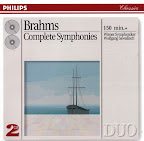
Brahms - The Complete Symphonies - Sawallisch, Wiener Symphoniker


Review:

Wolfgang Sawallisch, active as a conductor since 1947 he is now - at the age of 86 - very much an elder statesman of music and something of a legend in Philadelphia, with whose fine orchestra he spent his autumn years from 1993 to 2003. More to the point he is actually one of the twentieth century's supreme interpreters of Schumann, Bruckner and Richard Strauss, in many ways comparable to Günter Wand, whose sense for musical truth he always shared. Oddly enough his recordings of the Brahms symphonies (this one, and the one he made for EMI from 1989 to 1991 as well) have never been awarded any serious attention, an oversight I hereby hasten to remedy.

image Though always performing in the shadow of their cousins in the "Philharmonic" the Vienna Symphony is a fine orchestra, and in these inspired performances Sawallisch literally has every man jack playing fit to bleed from the cuticles. Though tempi are never rushed there is an intensity to every movement of these masterpieces that I have rarely encountered before or since, and the finale of the E minor symphony in particular takes us to dramatic heights that I think would have made even Furtwängler proud. The same is very much true for the finale of the D major symphony - played perfectly "molto ben marcato", and rivaled only by Takashi Asahina in his live recording, made when he was almost 90! - which rips open the indolence of that often rather leisurely pastoral work, letting fresh air sweep through every room.

The sound of these Philips re-mastering is very good and though the recording, true to its origins in the early 60's, is fairly closely recorded, is never too much. The various instrument sections are remarkably well defined.


flac, scans

Sunday, May 22, 2011

Brahms - Complete Trios (Piano,Horn,Clarinet) - Beaux Arts Trio, Grumiaux Trio

Review:

Brahms's chamber music has become a growing source of delight for me, and I'm increasingly coming to see it as his greatest achievement. He did everything, from string sextets to clarinet sonatas, and it was with his chamber music that he truly relaxed and let his gift for lyricism roam free. If his symphonic works were driven by the need to come to terms with and transcend Beethoven, thenJohannes Brahms his chamber music has Schubert's expansive generosity.

These trios are a great introduction, since they are drawn from every stage of Brahms's career. The Beaux Arts Trio offer definitive proof that it's best to go for an established ensemble rather than the superstar collaborations that record companies dream up to try and up their sales figures. There's an instinctive dialogue going on between these three veterans, and Brahms's two later piano trios are exquisitely done. Their approach is relaxed, with none of the reversion to manic keyboard hammering that seems to characterize many interpretations of Brahms's piano trios/quartets/ quintet. Brahms wrote his chamber pieces for clarinet toward the end of his life, and the Beaux Art Trio's interpretation is appropriately, wistfully autumnal. Like Brahms's other clarinet music, this piece is very special, and this is the most appealing interpretation I've heard. As for the horn trio, which isn't done by the Beaux Arts Trio, but features an ensemble led by Arthur Grumiaux, they just don't play music this way anymore.--C.Smith

flac,scans

Saturday, May 21, 2011

Johannes Brahms - The Complete Quintets - Haas, Berlin Philharmonic Octet


Review:

This outstanding CD collects all four of Brahms' Quintets as performed by pianist Werner Haas and/or members of the Berlin Philharmonic Octet from the early 1970s. Composers are generally known for their large-scale orchestral works. When you think of Brahms, what comes to mind? 4 large symphonies, 2 pianoimage concertos and a violin concerto. All huge works, worthy successors to Beethoven. Yet these all came relatively late in Brahms' career. His true love was a more pure form of music and in fact his chamber pieces far outnumber the larger works. Brahms was heavily influenced by folk music, which he regarded as  the essence of true music. Folk themes come through in these pieces, either Austrian lieder or the pseudo-Hungarian motifs so popular in Vienna in the latter half of the 19th century. This brings a certain enchanting simplicity to these works, easy on the palate with no bitter aftertaste. 


flac, scans

LinkWithin

Related Posts with Thumbnails