| Now that he is at the helm of the Berlin Philharmonic, Simon Rattle inevitably faces comparisons with the late Herbert von Karajan. The German conductor recorded both of these works with the Berlin Philharmonic, and Rattle's readings, finely controlled almost to the point of possessiveness, are, in their way, not unlike Karajan's, except more volatile. Especially in La Mer, the orchestral sound is almost too beautiful. Given Rattle's attention to detail, one almost loses the forest for the trees, as the cliché goes. Having said that, I must admit that Rattle is very seductive, and it is easy to be corrupted, if you will, by his Prélude à l'après-midi d'un faune and La Mer, if not completely satisfied in the long run. There are many fine recordings of both of those works, and Rattle's is yet one more. What makes this disc interesting, on the other hand, is the balance of the CD. La Boîte a joujoux is a ballet based on the imaginary lives of his daughter Chouchou's toys. Before his death, Debussy completed only a small portion of the orchestration, which was left to his pupil André Caplet. It is programmed and recorded rather infrequently, not because it is a weak work, but because it is not sensational, in the most literal sense of the word. This is, after all, music for dancers (or for puppets – at the time of his death, Debussy still was unsure as to how this work would be realized on stage). There is some "Mickey Mousing" in this ballet score, whose events include a battle between toys and a touching domestic scene for middle-aged dolls. Again, Rattle's reading is full of color and detail, and the score seems less pallid than it often does. The rhythms are sharp and there is nothing lazy about the playing, although Rattle doesn't fail to create a gently melancholy atmosphere in the work's later pages. The piano plays a featured role; here, Majella Stockhausen-Riegelbauer does the honors. more. What makes this disc interesting, on the other hand, is the balance of the CD. La Boîte a joujoux is a ballet based on the imaginary lives of his daughter Chouchou's toys. Before his death, Debussy completed only a small portion of the orchestration, which was left to his pupil André Caplet. It is programmed and recorded rather infrequently, not because it is a weak work, but because it is not sensational, in the most literal sense of the word. This is, after all, music for dancers (or for puppets – at the time of his death, Debussy still was unsure as to how this work would be realized on stage). There is some "Mickey Mousing" in this ballet score, whose events include a battle between toys and a touching domestic scene for middle-aged dolls. Again, Rattle's reading is full of color and detail, and the score seems less pallid than it often does. The rhythms are sharp and there is nothing lazy about the playing, although Rattle doesn't fail to create a gently melancholy atmosphere in the work's later pages. The piano plays a featured role; here, Majella Stockhausen-Riegelbauer does the honors. British composer Colin Matthews is orchestrating all 24 of Debussy's piano preludes, a project which many will find either foolhardy or sacrilegious. (It will be interesting to compare his La cathédrale engloutie to Stokowski's!) We get to hear three of them here: Ce qu'a vu le vent d'Ouest from Book 1, and Feuilles mortes and Feux d'artifice from Book 2. Matthews had no interest in imitating Debussy's orchestral scoring. Instead, he tried to find his own equivalent for Debussy's pianistic writing. The results are hyper-colorful, even in the dour Feuilles mortes, and even garish in Feux d'artifice. I guess it is to Matthews's credit that the results are spectacular and utterly convincing, even if they have little to do with Debussy. Here's something to confuse your friends with, then, after a few glasses of sherry. Rattle and the Berliners snap them up hungrily. With outstanding engineering and big, bold performances, this CD will give a great deal of sensory pleasure. There's nothing wrong with that!--Raymond Tuttle |
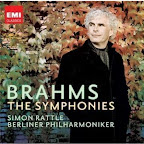
 revelatory as Rattle's earlier recording of the complete Beethoven symphonies with the Vienna Philharmonic. The combination of the incomparable sound and musicianship of the Berliner Philharmoniker and the iconoclastic, visionary approach that has characterized Sir Simon's music-making over the past thirty years is likely to result in a set of recordings that will challenge, invigorate, and refresh this well-known and cherished repertoire. Rattle's first Brahms recording with the Berliner Philharmoniker, Ein deutsches Requiem, won critical accolades and both Grammy® and Classic FM/Gramophone Awards. Now Sir Simon and the Orchestra have committed to disc the complete Brahms symphonies, recorded in concert at Berlin's Philharmonie in Autumn of 2008. In the words of Die Zeit, "Simon Rattle has finally dared to tackle Brahms with the Berliner Philharmoniker. He combines Furtwängler's monumentality with Karajan's beautiful sound . . .". Rattle confirms that performing these works with the Berliner Philharmoniker, which has been hailed as the world's greatest Brahmsian, orchestra "gives you a possibility of colours that you have almost nowhere else. . . . I can say to this orchestra, `I need a different sound' and the sound changes immediately."


%5B3%5D.jpg "Claude Debussy (1908)")


