|
|
|
Review:
ape, scans |
|
|
|
ape, scans |
Great news! Arkivmusic.com has gotten its "on demand" hands on the Japanese RCA Ormandy Edition, making these recordings available in North America at far saner prices. Some of these performances are outstanding, nowhere more so than here--one of the greatest Sibelius recordings ever made. Eugene Ormandy's Fourth Symphony is magnificent: gaunt, direct, and unflinching, with stunning string playing and the most intelligent approach on disc to the percussion conundrum in the finale (chimes at the "sonore" climax, glockenspiel everywhere else). Some listeners might prefer a swifter tempo in the scherzo, but this interpretation is all of a piece, taking in the work as if in one sweeping gesture, and Sibelians will understand just what that means.
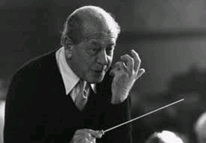
The Seventh also is a perfectly paced, immaculately played performance, with none of the mannerisms in the pastoral interlude that disturb Ormandy's first recording for Sony. As for the tone poems, there is no finer performance of Oceanides available anywhere, and Pohjola's Daughter is just about as good. Ormandy could come across as a somewhat stiff and unsmiling interpreter, but not here, and particularly not in music that requires an absolutely logical, indeed mathematical approach to tempo relationships between sections. Both in terms of performance quality and programming (Sibelius at his very greatest throughout), it just doesn't get any better.
The Japanese edition apparently used original unaltered sources, meaning the tapes were not remastered in any way, and so vary widely in sound quality--from very good, as here, to virtually unlistenable (Mahler Second). So until someone goes back and redoes them from scratch--and we may have a very long wait--you will have to buy selectively. These recordings, from the late 1970s, stand among the best-sounding of the lot. A magnificent release that you won't want to miss!—David Hurwitz
Ape, scans
Purists will assert that the Philadelphia Orchestra has no business playing Bach. It's too bad they feel that way, particularly when the conductor is Leopold Stokowski, reunited with the orchestra after a hiatus of almost two decades. Eugene Ormandy invited Stoki back in 1960, and MH2K62345 documents the results: confident, suave recordings of the Fifth Brandenburg Concerto and the conductor's moving arrangements of three Chorale Préludes. Ormandy was an expert arranger and conductor of Bach himself, as can be heard from the balance of this 2-CD set, which contains what used to be Columbia MS6180 ("Bach by Ormandy" – also recorded in 1960) and MS6342 ("The Bach Family" – works by Johann Christian Bach, Carl Philipp Emanuel Bach, and Wilhelm Friedemann Bach, recorded in 1957). None of it may be "authentic," but it all sounds luscious enough to make new friends for the music and the performances.
Ape, scans
Eugene Ormandy was a surprisingly dedicated Ives conductor, at least on disc, and a very good one too. This version of Three Places in New England was, if memory serves, the first of Ives' original scoring for full orchestra, and it's quite fine. As to be expected, the Philly players sound terrific, and
Ormandy seems to be enjoying himself (he was never noted for his sense of humor). The performance of the Holidays Symphony also stands with the very best; for many years this was the only way to get all four tone poems on disc, with Thanksgiving and Forefather's Day being a particular novelty. The sound is gratifyingly clear and clean for an RCA/Philadelphia production, save for some slight congestion at the entry of the chorus in Thanksgiving. Part of the Japanese RCA Ormandy edition, and now available on demand from Arkivmusic.com, this disc represented a major contribution to the Ives discography when it first came out back in the 1970s, and its qualities haven't diminished at all in the decades since.—David Hurwitz
flac, covers
Eugene Ormandy's Fifth is the earliest of his stereo Tchaikovsky symphony recordings for Sony, and it's one of the best. Not only do you get a typically lush, opulent performance, the strings still play with a healthy dose of "portamento" (which means sliding from one note to another). It's a delightfully sentimental style that has vanished completely--now it's considered bad taste. Tacky, maybe, but a great performance nevertheless. You'll just love it. --David Hurwitz

The main reason for recommending these performances is that Ormandy has the rich, expressive sound of the Philadelphia Orchestra, particularly in the lush strings, that is perfect for Rachmaninov and, further, he was a masterful interpreter of this music.
Ormandy elicits a powerful performance from his Philadelphia Orchestra. In these recordings one will hear the most riveting heights of the string section of the Philadelphia Orchestra. The sheer power of the strings is most evident in the riveting finale of the 2nd Symphony, its conclusion has no equal in any other recordings I have heard. You will listen to evocative surges of power and all the contemplative mystery that one would expect to hear from this orchestra.
What else could be expected from the orchestra and conductor that pioneered Rachmaninov's work for so many years? A great first choice for these works.
CD Content
# Symphony No. 2 in E minor, Op. 27
# Symphony No. 1 in D minor, Op. 13 (lost; reconstructed from piano duets and orch. fragments)
# Symphony No. 3 in A minor, Op. 44
# Vocalise, transcription for orchestra, Op. 34/14

A majestic and gorgeously played "New World" symphony, with an impressively lyrical Largo and powerful climaxes...

I cannot remember ever enjoying a Swan Lake record so much before. This is dazzling playing of the kind traditionally associated with Philadelphia. After their disappointing showing in two recent Tchaikovsky discs I was apprehensive, but the superb panache of the opening of Act 1 bowled me over, and each of the bravura numbers had just the same impact-the Danse espagnole, the Mazurka, the outrageous can-can of the Pas de deux variation. But this is far more than a slick professional job. Ormandy has judged the degree of rubato in the slow numbers very finely: with a less rich-toned orchestra than this more rubato could have been allowed, but as it is soupiness is completely avoided, I think of the violins playing of the opening of the Act 3 Pas de deux with an ecstatic little portamento up to the new phrase, perfectly judged. The melancholy, very Russian melody of the Dance of the Little Swans, too, has the most natural phrasing from the woodwind. Maybe some will want a less high-powered approach than this, but I never find it out of scale. This is highly recommended, particularly for those who have ever been jaded with this score. The choice of numbers could hardly be better : and the recording, both rich and brilliant, is particularly expansive in the stereo version.--Gramophone